Real Turkish. Real Connection. Real Fun.
Learning Turkish is a wonderful way for children to connect with their family, culture, and heritage. For families raising bilingual or multilingual children, finding the right learning method can make all the difference.
With so many language-learning apps available today, parents often wonder: Can my child really learn Turkish through an app, or would live online classes be more effective?
While language apps can be useful for learning vocabulary and practicing basic phrases, they often lack something essential: real human interaction.
At merhabakids, we believe children learn a language best when they use it to communicate, connect, and have fun.
Here’s why live Turkish classes offer advantages that language apps alone often cannot provide.
1. Real Conversations, Not Just Tapping on a Screen
Many language-learning apps rely on matching words, selecting answers, and repeating phrases. These activities can help children recognize vocabulary, but recognizing a word is not the same as being able to use it in a conversation.
At merhabakids, children participate in live, interactive 45-minute classes with experienced Turkish-speaking teachers.
Instead of simply identifying the word elma (apple), children learn to use it in everyday sentences:
• “Elma istiyorum.” – I want an apple.
• “Ben elma seviyorum.” – I like apples.
• “Elma kırmızı mı?” – Is the apple red?
Through real conversations, children gradually develop the confidence to express themselves in Turkish.
The difference: Apps help children practice words. Live classes help children use those words to communicate.
2. Small Groups Mean More Speaking Time
Language learning requires practice, especially speaking practice.
At merhabakids, our group classes have just 2–5 students, allowing every child to participate actively.
Children have opportunities to ask questions, answer their teacher, interact with classmates, and practice speaking in a supportive environment.
Unlike independent app-based learning, where children usually practice alone, small-group classes create opportunities for spontaneous conversation.
Children also discover that other kids around the world are learning Turkish just like they are.
This shared experience can be especially meaningful for children growing up outside Turkey.
3. Learning Designed Specifically for Children Ages 4–12
Not every language-learning method is appropriate for every age.
Many popular language apps were originally designed for adults or general audiences. Their vocabulary, learning structure, and activities may not always reflect how younger children learn best.
At merhabakids, our curriculum is developed specifically for children ages 4–12.
Our lessons incorporate:
• Games and playful activities
• Songs, stories, and visual learning
• Everyday conversations
• Repetition through meaningful sentence patterns
• Age-appropriate topics children can relate to
We believe children should experience Turkish as something enjoyable and natural, rather than another academic subject they must study.
4. Learning Sentences, Not Just Individual Words
Knowing hundreds of Turkish words doesn’t necessarily mean a child can speak Turkish.
A child might know the words su (water), içmek (to drink), and istemek (to want), but still struggle to say:
“Su içmek istiyorum.” – I want to drink water.
At merhabakids, our curriculum emphasizes listening, speaking, and sentence patterns.
Children learn how to combine words into meaningful expressions they can use in daily life.
Our goal isn’t simply to increase vocabulary. It’s to help children communicate naturally with parents, grandparents, relatives, and friends.
Because ultimately, the most rewarding moment isn’t when a child completes another app lesson.
It’s when they spontaneously say something in Turkish at home.
5. Personal Attention from Real Teachers
One of the biggest differences between language apps and live classes is the teacher.
An app can tell a child whether an answer is right or wrong. But a caring teacher can recognize why a child is struggling and adapt the lesson accordingly.
At merhabakids, our experienced, native-speaking Turkish teachers get to know their students.
They encourage shy children, challenge more confident learners, gently correct mistakes, and celebrate individual progress.
They also recognize when a child needs additional explanation, encouragement, or a different approach.
This personal connection helps create a positive learning environment where children feel comfortable experimenting with a new language.
6. Motivation Through Friendship and Connection
Language apps often use points, badges, and daily streaks to keep users motivated.
These features can be entertaining, but they don’t replace the motivation children gain from interacting with real people.
In a merhabakids class, children see familiar faces every week. They play games together, share experiences, and develop relationships with their classmates and teachers.
Learning Turkish becomes a social activity rather than an individual task.
And when children look forward to seeing their classmates, they are often more excited to participate.
We believe connection is one of the most powerful motivators in language learning.
7. Turkish Is More Than a Language – It’s a Connection to Culture
For many bilingual families, teaching Turkish isn’t only about vocabulary or grammar.
It’s about helping children connect with their roots.
It’s about understanding grandparents, communicating with relatives in Turkey, enjoying Turkish traditions, and feeling comfortable with an important part of their identity.
Language apps can introduce vocabulary and sometimes cultural content, but they may offer limited opportunities to explore the personal and cultural meaning behind the language.
At merhabakids, Turkish language and culture naturally come together through stories, conversations, celebrations, and everyday experiences.
We want children not only to understand Turkish but also to feel connected to it.
8. Structured Learning That Builds Confidence
With many apps, children can jump between topics, repeat familiar exercises, or focus primarily on collecting points.
At merhabakids, we follow our own structured curriculum designed to develop communication skills progressively.
Each lesson builds on previously learned vocabulary and sentence patterns, giving children repeated opportunities to practice and strengthen their skills.
Our teachers guide this process, helping children move from understanding individual words to expressing complete thoughts.
The objective is steady progress toward real communication, not simply completing exercises.
Are Language Apps Bad for Children?
Not at all!
Language-learning apps can be helpful supplementary tools. They offer convenient opportunities to review vocabulary, practice pronunciation, and reinforce concepts between lessons.
For some children, they can also be a fun introduction to Turkish.
However, apps work best as a supplement to real communication, not necessarily as a replacement for it.
A child who practices vocabulary on an app and regularly speaks Turkish with teachers, family members, or friends benefits from both approaches.
The key is creating opportunities to use the language meaningfully.
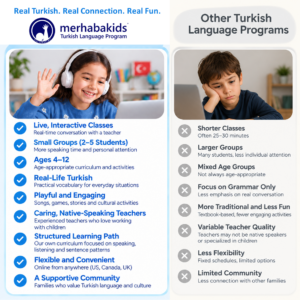
merhabakids vs. Language Apps: At a Glance
Give Your Child More Than Words. Give Them a Voice in Turkish.
We are happy to invite your child to a free trial class!
At merhabakids, our mission is simple: to help children speak Turkish with confidence, joy, and a genuine connection to their language and culture.
We believe children learn best when they feel supported, engaged, and excited to participate.
That’s why we combine small-group learning, experienced teachers, playful activities, and our own communication-focused curriculum.
Whether your child is just beginning to learn Turkish or already understands some Turkish at home, we would love to help them take the next step.
Experience the merhabakids Difference!
Join a free trial class and discover how enjoyable learning Turkish can be when children learn together.
Real Turkish. Real Connection. Real Fun.
merhabakids – Helping children connect through language.